
This blog is about raising meat rabbits, recipes, hunting, sausage making, urban farming, mushrooming, growing crops, and basically how to provide for your family and not destroy the world
Sunday, May 1, 2011


Friday, April 29, 2011
Greek Rabbit Stew with Artichokes
Greek Rabbit Stew with Artichokes
This recipe is adapted from one that appears in Diane Kochilas’ “The Glorious Foods of Greece,” which, in my opinion, is the last word on Greek regional cuisine. The recipe originates in Crete, where they eat a lot of rabbit, and a lot of wild greens. This works well in Northern California where I live, because we have lots of rabbits and lots of wild fennel, which is the preferred form in this recipe. If you can’t find it, look for the non-bulbing kind of fennel. If you can’t find that, just use the tops of bulb fennel and save the bulb for something else.
Do you need Meyer lemons for this? No, but they are sweeter (and I happen to have a tree of them in my back yard). Do you need a wild rabbit? No, but they are tastier — unless you get a specialty rabbit from someplace like Devil’s Gulch in California. And domestic rabbits are huge compared to their wild cousins: One domestic will feed four in this recipe.
You can also use squirrels for this, but not hares. You want a white meat here.
 Serves 4
1 domestic rabbit or 2 wild ones (or 2 squirrels), cut into serving pieces
2 cups white wine
1 cup Gigandes beans (you can use limas, but they’re not as good), soaked overnight
1/4 cup olive oil
10 scallions, 3 leeks or one large onion, sliced thin
1 cup all-purpose flour
6 artichokes, hearts and short stems only, halved
1 cup coarsely chopped fennel fronds
salt and white pepper
Rabbit stock or chicken stock
2 tablespoons flour
Juice of 2 lemons (Meyer or otherwise)
- Lightly salt the rabbit pieces. Boil the white wine until you can no longer smell alcohol (about 2-3 minutes), take off the heat and cool. Once it’s cool, add the rabbit and marinate overnight in the fridge.
- The next day, take the meat out of the fridge, pat dry and let come to room temperature for at least 1/2 hour.
- Preheat oven to 275 degrees.
- Once the rabbit is ready, dredge it in the flour and brown it on all sides in the olive oil over medium heat. Use a brazier, Dutch oven, or a heavy pot with a lid for this. Once the rabbit is browned, remove and set aside.
- Add the scallions or leeks into the pot and saute over medium-high heat until you get some color. No burning the onions!
- Add about a 1/2 cup of the white wine marinade to deglaze. Let it reduce by half, mix well, then add back the rabbit pieces and the gigandes beans. Add rabbit or chicken stock until it covers the rabbit pieces by about a quarter inch. Cover and put in the oven for at least 2 hours. You ultimately want the rabbit to be giving to the probe of a fork.
- Somewhere around that 2-hour mark — no later — check to see if the rabbit is beginning to submit, and if so add the artichokes and half the fennel, then check for seasoning and add salt if necessary. Add some white pepper at this point. Make sure everything is neatly arranged in the pot and not sticking, then cover again and give the lot another 30 minutes.
- Once the 30 minutes are up, check everything. You need the rabbit to be tender. If it isn’t put it back in. Once it has submitted to your liking, turn off the heat and make the lemon sauce. Whisk flour and lemon juice together, then add a ladleful of the stew into it, whisking all the time. Do this again, then add it to the stew and stir to combine carefully; think of it more as folding in the lemon sauce rather than whisking or stirring. Cover and let it rest for 5 minutes.
- Garnish with the rest of the chopped fennel, a little more white pepper, and serve with rice or good crusty bread.
Rabbit in Mustard Sauce
Rabbit in Mustard Sauce
Print Options

Simply Recipes contributor Hank Shaw and I "met" years ago over a comment he made about rabbit on Michael Ruhlman's blog. I hounded him for a rabbit recipe back then so I'm delighted that he is sharing this French classic with us now, Lapin à la moutarde, or Rabbit in Mustard Sauce. ~Elise
This is a French country classic, and there are endless variations. All are good. Some recipes bake the rabbit, others braise it, as I do. The keys are mustard—good grainy mustard, not the bright yellow stuff you get at the ballpark—shallots, and something creamy. I use heavy cream, but some people use crème fraiche, others sour cream.
Rabbit has a mild flavor that is all its own. Think chicken breast, but with a slightly different flavor. It is one of my favorites, although I mostly use wild cottontail rabbits. Domestic rabbit is readily available frozen in good supermarkets, and any decent butcher can get you some. And yes, if you are skeeved out by rabbit, use chicken instead. But rabbit is better.
This is a French country classic, and there are endless variations. All are good. Some recipes bake the rabbit, others braise it, as I do. The keys are mustard—good grainy mustard, not the bright yellow stuff you get at the ballpark—shallots, and something creamy. I use heavy cream, but some people use crème fraiche, others sour cream.
Rabbit has a mild flavor that is all its own. Think chicken breast, but with a slightly different flavor. It is one of my favorites, although I mostly use wild cottontail rabbits. Domestic rabbit is readily available frozen in good supermarkets, and any decent butcher can get you some. And yes, if you are skeeved out by rabbit, use chicken instead. But rabbit is better.
Rabbits usually come whole, and if you don’t know how to break them down yourself, ask the supermarket butcher to do it for you. This gets a little harder with frozen rabbits, so I’ve posted step-by step instructions on breaking down a rabbit here.

Rabbit in Mustard Sauce Recipe
Print Options
- 30 minutes
- 1 hour
You will probably get the kidneys with your rabbit. It is your choice whether to keep them or not. I always do, and I think they are the second-best part of the animal after the hind legs. Rabbit kidneys are mild in flavor and are a warm, soft, rabbity morsel in this dish. If you choose to use them, strip off all the fat, as well as the gossamer membrane that surrounds them.
Ingredients
- 1 rabbit, cut into serving pieces (see How to cut up a rabbit)
- Salt
- 4 tablespoons butter
- 2 large shallots, chopped
- 1/2 cup white wine
- 1/2 cup water
- 1/2 cup grainy country mustard, like Dijon
- 1 teaspoon dried thyme
- 1/2 cup heavy cream
- 4 tablespoons finely chopped parsley
Method
1 Salt your rabbit pieces well and set aside at room temperature for 30 minutes to an hour.2 Heat the butter over medium heat in a large sauté pan with a lid. Pat the rabbit pieces dry and brown them in the butter. Do this at a moderate pace – you don’t want the butter to scorch – and don’t let the rabbit pieces touch each other. Do it in batches if you need to.
Once the rabbit is browned, remove it to a bowl. Add the shallot and brown it well. This will take 3-4 minutes.
3 Pour in the white wine and turn the heat to high. Scrape off any browned bits on the bottom of the pan with a wooden spoon. Add the mustard, thyme and water and bring to a rolling boil. Taste the sauce for salt and add some if needed.
4 Add the rabbit pieces, coat them with the sauce, then drop the heat to low. Cover and simmer gently for 45 minutes. You want the meat to be nearly falling off the bone. It might need more time, but should not need more than an hour total. Wild rabbits sometimes need more time.
5 When the meat is ready, gently remove it to a platter. Turn the heat to high and boil the sauce down by half. Turn off the heat and add the cream and parsley. Stir to combine and return the rabbit to the pan. Coat with the sauce and serve at once.
Serve this dish with crusty bread and a big white wine, such as a white Bordeaux, white Cotes du Rhone blend or a buttery California Chardonnay. If you prefer beer, try pairing this with an unfiltered wheat beer.
Yield: Serves 4.
How to Cut Up a Rabbit
How to Cut Up a Rabbit
May 19th, 2010 | By Hank Shaw | Category: Cooking Basics | Comments | 33 Comments |
Photo by Holly A. Heyser
Butchering a rabbit is indeed harder than cutting up a chicken. In fact, that reason — along with a slightly higher feed-to-meat ratio, is why America became a nation of chicken-eaters and not rabbit-eaters. The question was actually in doubt a century ago.
Now meat rabbit production in the US is less than half what it was even in 1985, and we eat only about 17,000 tons a year, according to one 2005 survey — compare that with Italy’s 300,000 tons. Buon Appetito!
The buttermilk fried rabbit you see above is now largely a Southern novelty or a hunter’s special. Pity, because it is every bit as delicious as a perfect fried chicken.
Most of the rabbits and hares Holly and I eat are wild cottontails or jackrabbits, although an occasional snowshoe hare or domestic rabbit finds its way to our table. And it’s a domestic I decided to work with for this tutorial.
Why butcher your own rabbits? They’re cheaper, sometimes a full $1.50 a pound less than a pre-portioned bunny. Also, if you are raising your own or are a hunter, this is good information to know.
First you need a very sharp knife: I use a Global flexible boning knife, but a paring knife or a fillet knife would also work, as would a chef’s knife. I also use a Wusthof cleaver and a pair of kitchen shears. Have a clean towel handy to wipe your hands, and a bowl for trimmings.
Start by picking over the carcass for silverskin and sinew, and slice it off. You’ll be doing a lot of this, but you might as well get started with the easy stuff.
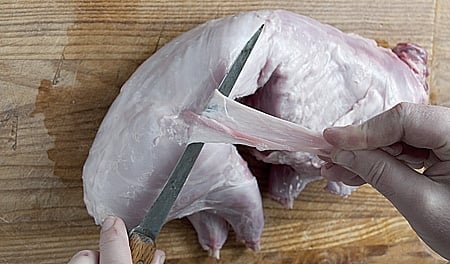
Photo by Holly A. Heyser
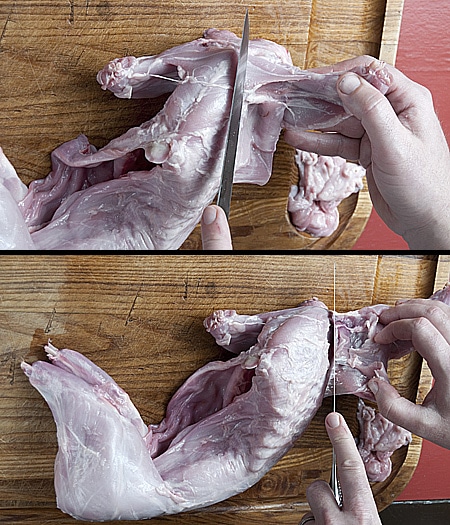
Photo by Holly A. Heyser
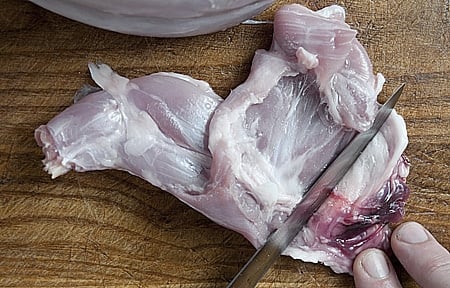
Photo by Holly A. Heyser
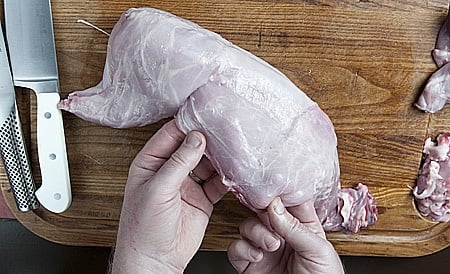
Photo by Holly A. Heyser
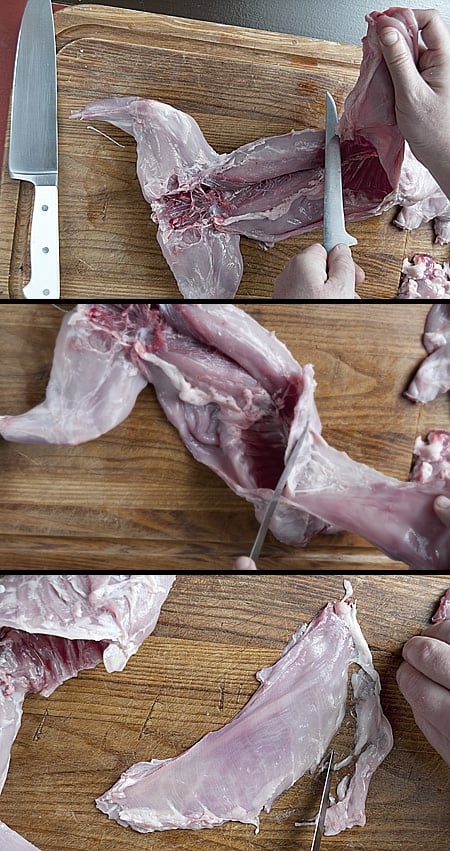
Photo by Holly A. Heyser
Start on the underside and slice gently along the pelvis bones until you get to the ball-and-socket joint. When you do, grasp either end firmly and bend it back to pop the joint. Then slice around the back leg with your knife to free it from the carcass.
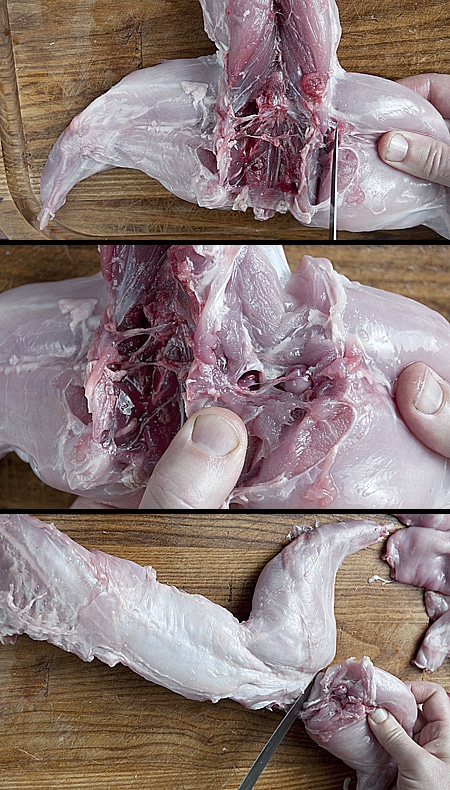
Photo by Holly A. Heyser
Now is a good time to remove a little more silverskin. The back of the loin has several layers, and most need to be removed. The final layer is very tough to cut off, and I often leave it. On a large hare or jackrabbit, however, this layer needs to go, too.
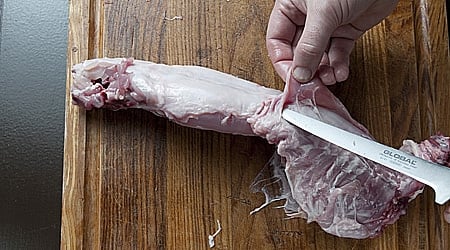
Photo by Holly A. Heyser
Start by removing the pelvis, which is really best in the stockpot. I do this by taking my cleaver severing the spine by banging the cleaver down with the meat of my palm. I then bend the whole shebang backwards and finish the cut with the boning knife.
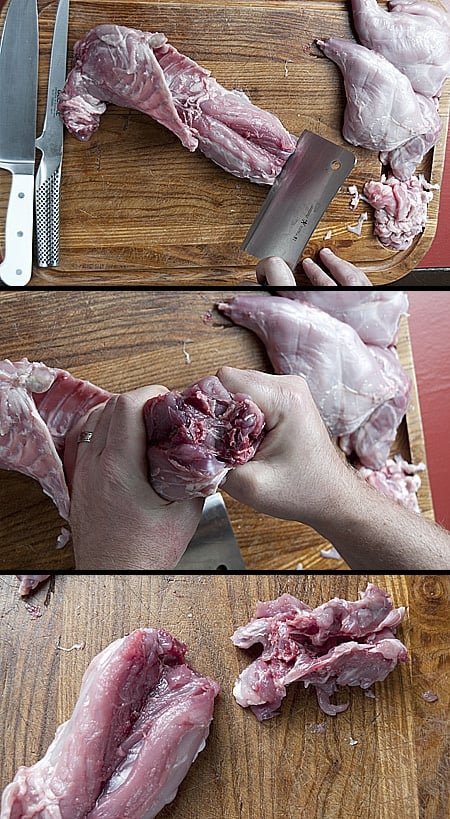
Photo by Holly A. Heyser
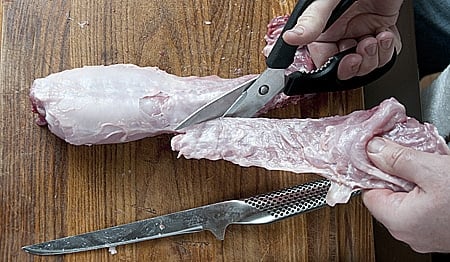
Photo by Holly A. Heyser
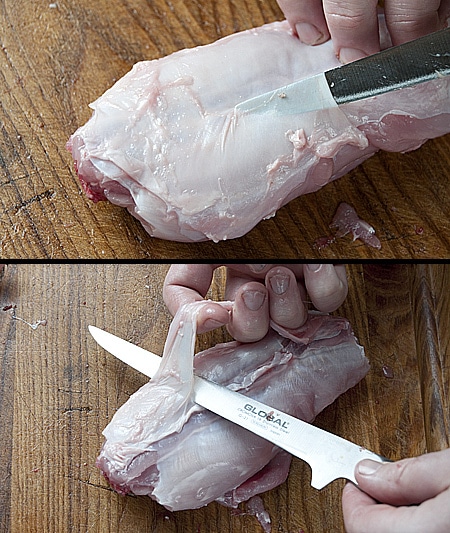
Photo by Holly A. Heyser
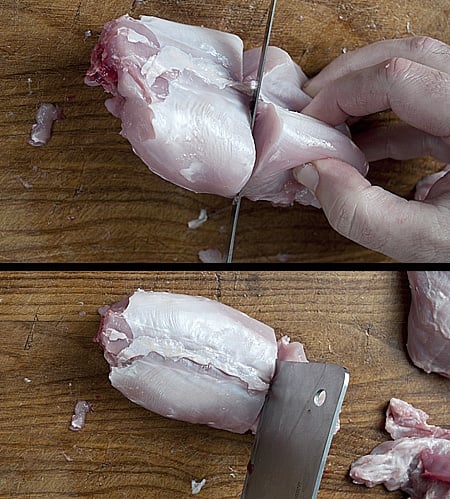
Photo by Holly A. Heyser
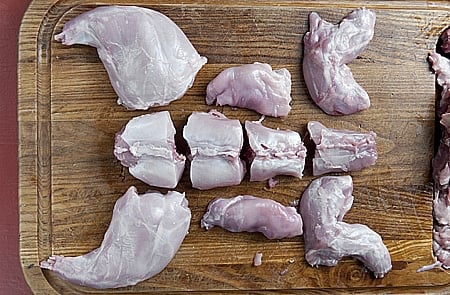
Photo by Holly A. Heyser
What to do with your newly portioned rabbit? Well, you could browse through my rabbit recipes. But since Holly and I so rarely get to eat domestic rabbit, which we know will be tender, I decided to fry it like a chicken.
I used my friend Elise’s buttermilk fried chicken as a model, although I kicked up the paprika and spices a bit. Here is my fried rabbit recipe. With an ice cold beer, it was every bit as good as it looks!

Photo by Holly A. Heyser
Want to Learn How to Make Pasta & Sausage?

Photo by Holly A. Heyser
Here are the details:
The Whole Foods class will be all about making pasta without a pasta maker. Lots of people want to make pasta, but don’t necessarily want to spend all kinds of money on a pasta machine. Fortunately there are lots of pasta shapes that are easy to make without one.
I will go over basic dough-making, making doughs with flours other than wheat — spelt, chestnut, farro, barley, chickpea, etc — and then we will all make several traditional Italian shapes. The exact shapes are to be determined, but I am planning on:
- Pici, a fat, hand-rolled spaghetti from Tuscany
- Cavatelli, a cup-shaped short pasta common in Southern Italy
- Strascinati, a similar Southern Italian pasta that looks a little like an empty pea pod
- Sardinian semolina gnocchi, which look like little chickpeas
The class will be Saturday, May 7 at the Whole Foods on 4315 Arden Way in Sacramento. It will start at 5 p.m., and the cost is TBD, but it will be $50 or less per person. I will update this post when I hear what the actual cost will be. Once the class appears on the store’s calendar of classes, you can call 916 488 2800 or register for the event here.

Photo by Holly A. Heyser
That class will be limited to about 20 people so I can give everyone the attention they need to learn how to make professional-quality sausages at home. We will be using Kitchenaid grinders, and I will bring my sausage-stuffing machine to demonstrate.
We’ll go over meat safety, different types of sausage, effects of different spices and meats and grinds, and then we will make some basic Italian sausages.
I understand that most people won’t have access to a proper sausage stuffing machine, so we will do more than make links. I will show you how to make sausage patties, how to use alternative wrappers (like cabbage and grape leaves) for sausages, as well as how to make French crepinettes using caul fat.
That class will be Saturday, May 14 starting at 11 a.m. Tentative cost will be $95 plus tax, and registration will be capped at about 20 people. You can call 415 339 4700 to reserve your spot, or check this link for more details.
Hoping to see some of you there!
Worried about New Farming
By Lynn Miller (Originally copyrighted in the Fall 2009 Small Farmer’s Journal)
 Industrial agriculture is fighting for its scientific, political and economic life. The public drum beat for a new farming is growing louder every day. The citizenry want safe, healthy food – they want the security and the civilizing regional diversities which come of a vibrant local food scene – they want the independent family farms to succeed and thrive – they want to see small rural communities come alive again for all the right reasons.
The vertically-integrated corporate behemoths, wholly separate from actual farmers and farming, are heading off a steep cliff of their own design, they are living the curse of rapidly decreasing returns on investment as vital natural resources are depleted and/or altered by the boardroom’s complete disregard for natural balance and fertility – their disregard for bio-diversity and the true craft of farming.
Meanwhile in nearly every nook and cranny of this land people are getting together local community efforts to answer their increasing need for real local food security and health; farm coops, “foodsheds,” farm to consumer alliances, new farm beginnings programs, and so much more.
The executive and legislative branches of our government are justifiably confused. Who now exactly is the constituency? The general clamoring voting food-eating public – or the money slinging black-mailing corporate board members? The answer would seem to be obvious but alas…
Now we are beginning to see the hard evidence of a campaign to “dis-allow” the public in general and small farms in particular. In other words we farmers and consumers are being stripped of our determinate rights, If the federal-corporate axis have their way, we won’t get to have a say in what sort of farming and food we will have in the near future.
Over the last half-dozen years the USDA and its corporate controllers have worked out a program to demand through regulation, the “professionalization” of agriculture. “No more amateurs” they cry. We see it in the circumlocutions of the euphemistically labelled “Food Safety Bills” and we hear about it today as the secretary of agriculture announces an end-run to implement Animal ID as imbedded within food safety regs.
They are worried and with good reason. The cause of new farming is winning at the grass-roots level across all sociological boundaries. The federal/corporate axis wants to make us, in the new farming, fight their fight. We mustn’t. We must continue our constructive efforts everywhere, we must take our solutions to them. Make them “show cause.” This country must reclaim the capacity to feed itself – not in some abstracted third-removed corporate trade off but ACTUALLY feed itself. It is not only a matter of national security, it is a moral and cultural imperative that affects the survival of the planet and the dignity of mankind. At every opportunity we need to request from our governments and the large corporations that they pass a litmus test, Do they or do they not support the concept of U.S. self-reliance in food? Do they or do they not support the SFJ demand for a whole New Homestead act granting each and every veteran either a college education or a suitable piece of land to farm? Do they or do they not support the goal of zero hunger in this country and around the world? Do they or do they not support the furtherance of farming systems which enhance the biological world? Yes or no? Time to go on record. And know that when you do go on record that record will be called upon when we decide where to shop, who to vote for, what to watch, who to dial in. It’s no longer a contest. The new farming has won out. But it is no time to lower our guard, it’s no time to slow our efforts, no time to trade off any of our principles. They are worried and that is clear evidence of something that has already happened. Let us not be swayed or hoodwinked into fighting their fight. LRM
Subscribe to:
Posts (Atom)